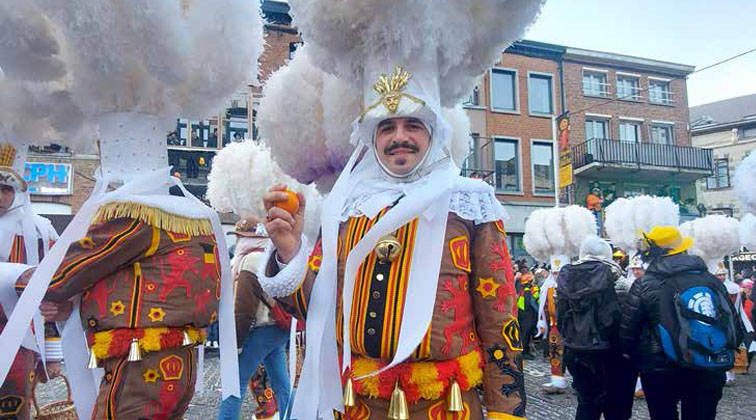
“Feathers, Masks, and Heritage: The Story Behind the Carnival of Binche” Belgium - When we hear “Mardi Gras” or “Fat Tuesday” celebrations, places like New Orleans, Rio de Janeiro, and Venice instantly come to mind. But did you know that this celebration also takes place every year in Belgium? In the Hainaut province, south of Brussels, the Carnival of Binche is one of the most popular. It is recognized by UNESCO as an Intangible Cultural Heritage of Humanity and stands as a symbol of the region’s identity and unique folklore. What’s more, the merrymaking begins even before Mardi Gras itself. “Dimanche Gras” marks the colorful opening day of the three-day carnival, featuring masks and elaborate costumes worn by local societies, or “cagnottes.” The future Gilles who have not yet donned their traditional attire as well as the Paysans (Peasants), Pierrots, and Harlequins, wear vibrant fantasy costumes. In the morning, participants go from house to house to the rhythm of drums and viols, gathering in small groups. The grand “Shrove Sunday” procession begins at 3:30 p.m., winding through the city center before concluding around 6 p.m. The night continues with music and drumming late into the evening. Unlike Tuesday, the Gilles do not wear their traditional costumes, masks, or hats on Sunday; instead, it is a time for creative, customized, and often secret costumes. “Lundi Gras,” or Shrove Monday, is another important part of Binche folklore, highlighting the youth and children of the town. While Mardi Gras is dominated by the adult Gilles, Lundi Gras features youth societies and lively confetti battles. Three organizations—the Royal Jeunesse Catholique Binchoise, the Jeune Garde Libérale, and the Jeunesse Socialiste Binchoise—have been united for around 25 years under the ADL (Association for the Defense of Lundi Gras), working together to...... Read more on Full Issue!